
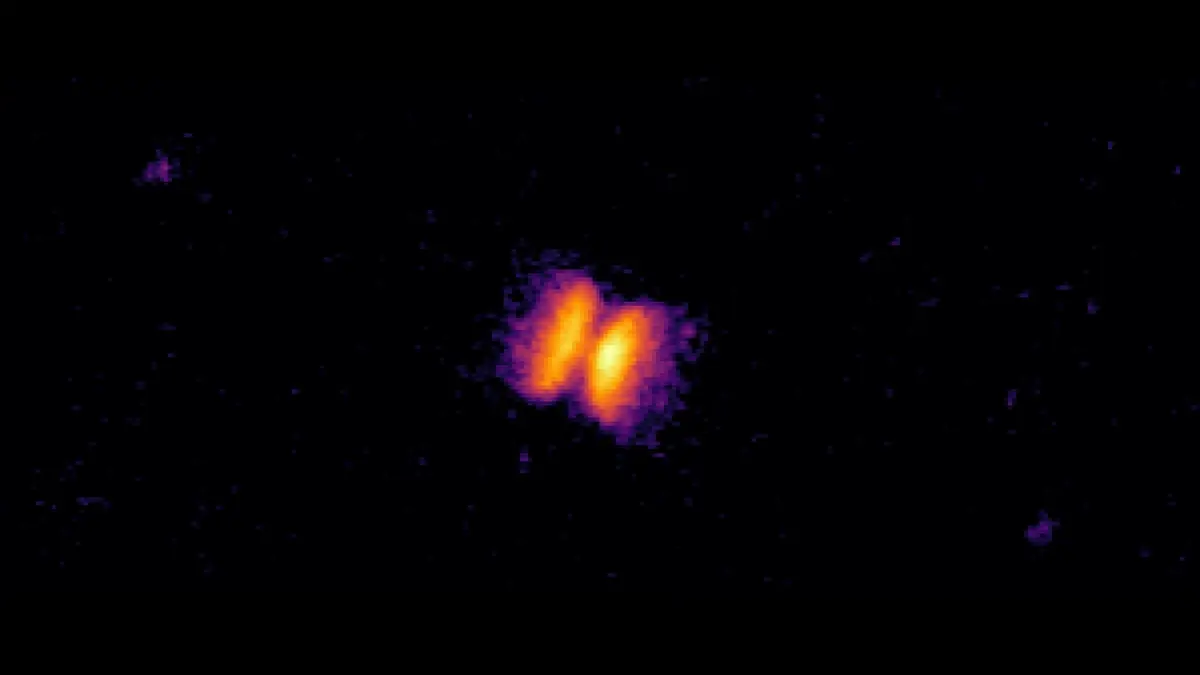
Astronomers have found gas clumps moving at up to 32 million km/h in the outflow from the helium nova V445 Puppis, the Royal Astronomical Society reported.
V445 Puppis remains the only confirmed helium nova in the Milky Way. The system erupted in late 2000, after which a thick dust disc hid the stars that make up the system for more than two decades.
Researchers combined infrared observations from the Very Large Telescope, Hubble imaging, long-term spectroscopy from the Southern African Large Telescope and photometry from the TESS mission. The data confirmed that a white dwarf is drawing material from a rare helium star that has lost its outer hydrogen envelope.
Separate clumps, possibly rich in oxygen, were found in the bipolar outflow. They are travelling at up to 20 million miles per hour, or roughly 32 million km/h.
The origin of these “bullets” is a mystery. We suspect that these originated post-outburst, but “bullets” of this kind have not been observed in any other nova — John Mills, researcher and PhD student at the University of Warwick
The observations also show that material transfer in the system has resumed. The researchers estimate that the two stars orbit each other every 3.7 days, almost twice as long as previously thought.
Scientists suspect that repeated helium-rich eruptions may offer one route to a Type Ia supernova. This remains a hypothesis: the authors stress that the connection between helium novae and such explosions still requires further testing.